Wurdella player guide
Wurdella Clue Guide
The clue is not meant to replace board reading. Wurdella gives one clue during rows 1–3, and using help reduces the score available from the round. The useful question is therefore not 'Can I press it?' but 'Will the information change my candidate list enough to justify the cost?'
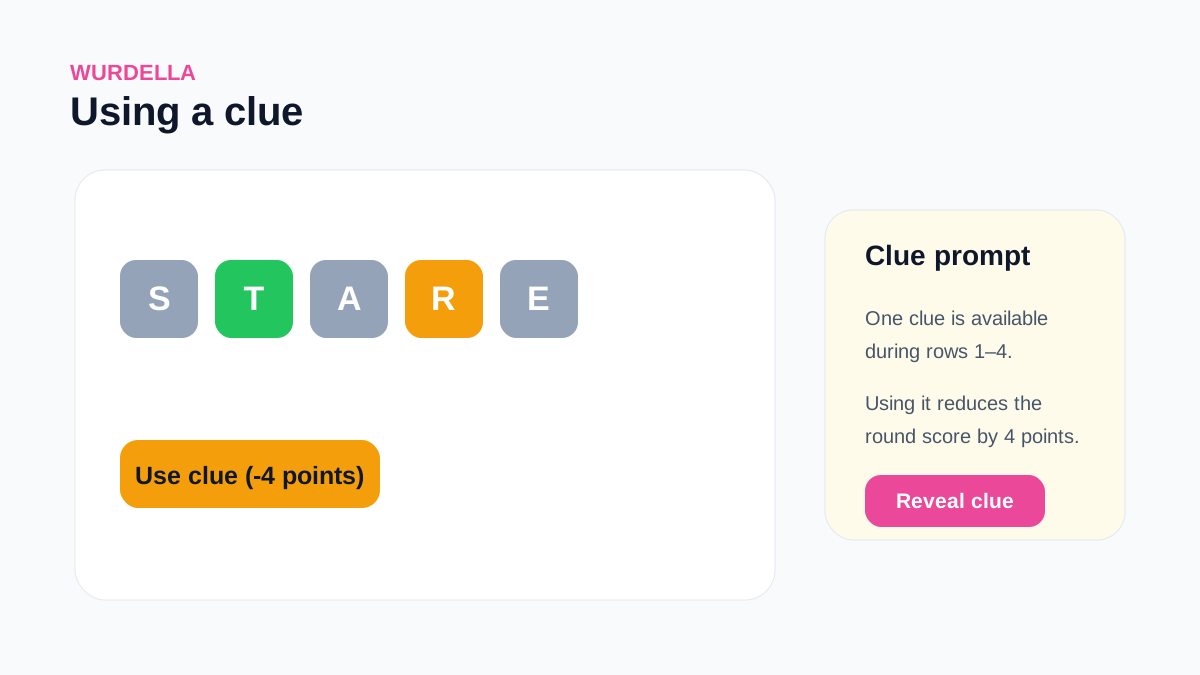
The clue window is rows 1–3
The clue must be used during the early part of the round. After row three, the window closes and the rest of the solve depends on the board and your candidate logic.
This timing gives the hint enough remaining guesses to matter without turning it into a last-row answer reveal.
Worked examples
- • Row 1: usually gather normal feedback first.
- • Row 3: often the strongest rescue point if several answers still fit.
Use a clue only when it removes real uncertainty
List the realistic answers that still satisfy every tile before revealing help. If one common answer remains, the clue buys little. If several unfamiliar candidates survive, meaning-based information can be extremely valuable.
After seeing the clue, rebuild the candidate list immediately. If no possibilities disappear, reread both the hint and the board before guessing again.
Difficulty changes how valuable a clue feels
Kids and Default often contain vocabulary familiar enough that position logic can carry the solve. Advanced and Expert are more likely to produce a pattern-valid word the player does not know well.
That makes semantic help especially useful in harder modes, although the score trade-off still applies.
Keep competitive clues fair
In local multiplayer or team play, clue information should remain with the active player or team when the interface treats it as private. Shared tile feedback belongs to everyone; purchased semantic help should not become free information for opponents.
The same principle applies in remote Challenge a Friend matches.
Turn the clue into vocabulary learning
If the clue introduces a meaning you did not know, connect it to the solved answer after the round. Read the definition, say the word aloud and use it once.
That turns the scoring sacrifice into something useful beyond the immediate board, especially in Advanced and Expert.
Know the exact clue window
Wurdella offers one clue during rows 1–3. After the third submitted guess, the clue is no longer available, so the decision belongs to the early part of the round rather than the last desperate row.
That timing is intentional: a clue should influence several remaining decisions, not function as a nearly automatic final-answer reveal.
Worked examples
- • Row 1: usually gather normal board feedback first.
- • Row 2: consider a clue only if the vocabulary already looks unfamiliar.
- • Row 3: the strongest rescue point when several candidates still fit.
- • After row 3: solve from the board; the clue window is closed.
A clue is valuable only when it changes the candidate list
Read the board before using help. If you can already name one realistic answer that satisfies every green, yellow and exclusion, a clue is unlikely to earn back the score it costs. If five unfamiliar words fit the same pattern, meaning-based information can be extremely valuable.
After revealing the clue, immediately rebuild the candidate list. The clue has done its job only if some possibilities become less plausible or disappear entirely.
Use clues differently in Kids, Default and Expert
In Kids and Default, the answer is more likely to be familiar enough that board logic can carry the solve. In Advanced and Expert, the player may derive the spelling from constraints before recognizing the vocabulary, which makes meaning-based help more valuable.
The best clue policy therefore depends on the purpose of the session. A child learning spelling may benefit from a gentle semantic prompt, while an experienced player testing pure deduction may choose a no-clue challenge.
Keep competitive clue information fair
In local competitive play, clue information should stay with the active player or team if the mode presents it privately. Shared letter feedback belongs to everyone; purchased semantic help should not automatically become free information for the opposition.
For remote Challenge a Friend matches, the same fairness principle applies: use the interface as intended and avoid forwarding private help to the other player.
When a clue is probably worth the score
A clue is often justified when several legal answers remain, the vocabulary is unfamiliar, the current match makes a lost round especially costly or the player is learning and the extra meaning will keep the puzzle productive.
It is usually poor value when four letters are fixed, one common answer fits or the player has not yet taken time to process the visible tile feedback.
- ✓ Use it when meaning can eliminate several real candidates.
- ✓ Skip it when the board already points to one obvious answer.
- ✓ Do not use it merely because the button is visible.
- ✓ Decide before row 3 ends.
Turn a clue-assisted solve into learning
If the clue introduces a meaning you did not know, keep that information after the round. Read the final definition, say the word aloud and connect the clue to the answer. That turns the scoring trade-off into a vocabulary gain rather than a one-time rescue.
This is especially useful in Advanced and Expert, where solving from pattern alone may reveal a word the player has never actively used before.
Next step
Use the guide on a real board
Try the guide on a real board in unlimited play, compare actual word patterns in the Word Finder or use Challenge a Friend when the guide is about competitive play.